

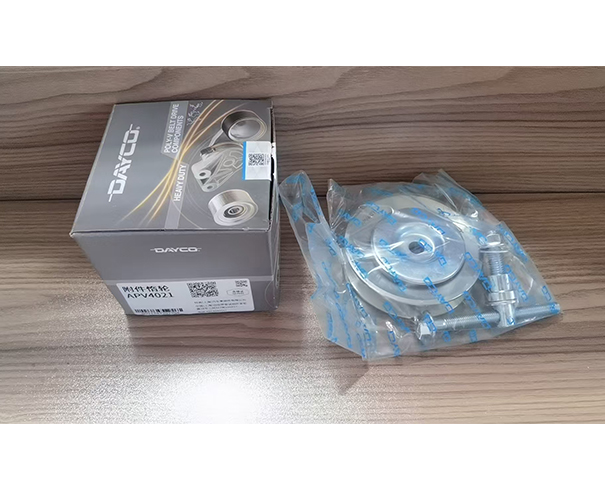
The engine Belt tensioner,also known as the automatic tensioner,is a key component of the engine accessory transmission system.It works together with the belt and idler to continuously provide constant tension to the fan belt and multi wedge PK belt,driving the Water Pump,generator,and air conditioning compressor to operate normally.If the tensioner fails,the belt will slip,shake,or even fall off,directly causing the engine to overheat and not charge,leading to work stoppage on the construction site,and seriously causing engine cylinder damage.
The automatic tensioning wheel assembly mainly consists of a shell swing arm,torsion spring,damping and shock absorption mechanism,wheel body,and built-in bearings.When the engine is working,the belt will be stretched by heat and stretched during use.The internal spring pushes the pressure wheel through the swing arm,automatically compensating for the change in belt length and maintaining appropriate tightness;Damping mechanism is used to suppress belt shaking and jumping at high speeds,reducing impact vibration.The idler only serves as a guide and does not provide tension,and its function cannot be confused with that of a tensioner.
Divided into automatic spring type tensioners and old-fashioned manually adjustable tensioning wheels.Nowadays,the vast majority of electronic fuel injection excavators use automatic tensioning assemblies,which do not require manual repeated adjustment of tension.The groove type of the wheel body must match the belt,with V-grooves corresponding to V-belts and PK grooves corresponding to multi wedge belts.The internal bearings are exposed to high temperatures,dust,and oil pollution in the engine room for a long time,constantly subjected to radial alternating pressure,and belong to consumable parts.
Under heavy load conditions in mines,the engine continues to operate at high speeds,and the tension wheel springs and bearings are heavily loaded,leading to an accelerated aging rate;The load of earthwork conditions is relatively stable.The fault of the tensioning wheel will not sound an alarm separately,mainly manifested as abnormal belt whistling,belt jumping,and the swing arm reaching the limit position.Many repairs only replace the belt and ignore the aging tensioner,causing the new belt to slip and damage again in a short period of time.
The price of the tensioner itself is not very high,but the secondary damage caused by failure is significant.It is generally recommended in the industry to inspect both the tensioner and idler when replacing the belt,and replace them simultaneously if necessary.Familiar with the principle of tensioning wheel structure,able to identify abnormal swing arm and bearing noise in advance,avoid the risk of sudden belt breakage,and ensure the continuous operation of excavators.
 RELATED
 RELATED
 RELATED
 RELATED
This website uses cookies to ensure you get the best experience on our website.
 Español
 Pусский
 Français
 العربية